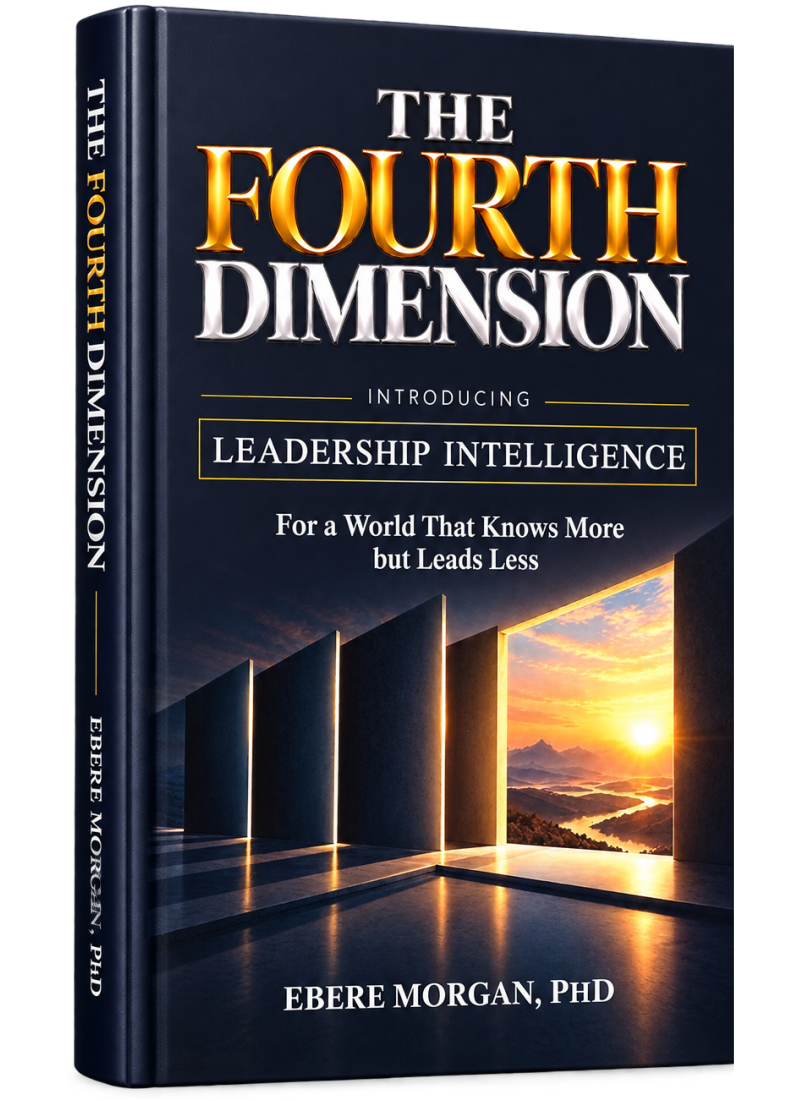
The Fourth Dimension
Introducing Leadership Intelligence for a World That Knows More but Leads Less
We know more than ever.
We lead no better
Nokia had the talent and the truth could not travel. Organizations and nations keep failing in the same place: between what they know and what they do.
The book names that gap the intelligence illusion, the belief that knowing more means leading better.
We have cultivated the intelligence to know. We have learned more about the intelligence to feel. We have deepened our understanding of the intelligence to relate. But we have not adequately understood the intelligence to lead.
Not a fourth item on a list. A fourth dimension.
Leadership Intelligence (LQ) is the capacity that turns knowing, feeling and relating into change that lasts.
The intelligence to understand.
The intelligence to perceive and care.
The intelligence to connect.
The intelligence to lead what we know toward what matters.
Leadership is the intelligence capacity to actualize change through influence, in people, by people, and for people across time.
The Leadership Trifecta
Every leadership moment can be read through three questions.
Who is involved and affected?
How does intention become coordinated movement?
What meaningful difference does it make?
People are not merely where leadership happens. They are how leadership travels.
Praise for the Book
“…knowledge alone does not build nations. The Fourth Dimension identifies a critical deficiency in governments and institutions, the capacity to actualize what they already know.”
“When you measure and elevate your Leadership Intelligence, you elevate the people around you. Dr. Morgan offers a powerful, practical roadmap for doing exactly that.”
“This is more than theory: it is an operational doctrine for converting knowledge into judgment, influence into trust, and vision into institutional legacy.”
An executive once told me that the important thing was not the university on your degree, but what you did with that degree afterward. That wisdom captures the question at the heart of The Fourth Dimension: humanity has amassed extraordinary knowledge, but what becomes of all that we know? Dr. Morgan does not merely append another letter to the alphabet of intelligences. He rolls up his sleeves and asks how knowledge, judgment, human agency, and purpose become real consequences. His argument reaches nations and institutions without losing the individual. This book is meant to be applied. Get. Read. Apply.
Amid the transformations of the Fourth Industrial Revolution, The Fourth Dimension makes a significant contribution to leadership scholarship. Prof. Morgan illuminates an often-overlooked human capacity: translating what people know, feel, and understand into consequential change through human systems. His account places ethical responsibility and sustainability at the center of leadership, rather than treating them as afterthoughts. Particularly impressive is the clarity with which he makes sophisticated concepts accessible without sacrificing their intellectual significance. Students, scholars, practitioners, and public leaders will find this an illuminating and valuable work.
Leadership’s defining question is not simply how much we know, but what we do with that
knowledge. The Fourth Dimension confronts this question in a way that speaks directly to the
demands of leading people, strengthening institutions, and generating lasting results. For African
leaders navigating rapid change, Dr. Morgan’s idea of Leadership Intelligence offers a useful lens
through which to examine responsibility, decision-making, and the future we are building. This
book invites serious reflection, and, more importantly, purposeful action.
Institutions do not move forward on information alone. In The Fourth Dimension, Dr. Morgan
advances a visionary, systems-based understanding of leadership that asks how knowledge
becomes coordinated action and how strategy becomes durable progress. His framework is
especially relevant to leaders navigating complexity while remaining accountable to the people
their institutions serve. This is an important invitation to lead beyond the acquisition of expertise
and toward meaningful, lasting impact.
As a physician-scientist and global pharmaceutical executive, I have learned that expertise alone
rarely transforms an organization. Evidence must inform judgment; judgment must earn
confidence; and people must be mobilized around a purpose they can sustain. That is why Dr.
Morgan’s The Fourth Dimension matters. His concept of Leadership Intelligence gives a
coherent account of how knowledge, influence, and human potential become purposeful, enduring change. It is a notable contribution to contemporary leadership thinking and an especially useful challenge to those who assume technical mastery is sufficient to lead.
People and transformative change have always been the heart of my leadership: building, mentoring, and championing what others can become. In The Fourth Dimension, Dr. Morgan
describes leadership as a human capacity to perceive possibility, exercise judgment, mobilize collective action, and turn aspiration into reality. His vision of change ‘in people, by people, and for people across time’ captures what I have sought to practice. This book connects people,
purpose, and possibility in a way that can change lives, strengthen industries, and help
institutions thrive long after an individual leader has gone.
At a moment when artificial intelligence is expanding what humanity can accomplish, The Fourth Dimension raises a more searching question: is our capacity to lead advancing at the same pace? Dr. Morgan brings knowledge, emotional maturity, relationships, judgment, and purpose into a coherent account of responsible leadership. Most importantly, he reframes leadership as stewardship. Its measure is not personal prominence, but what people and institutions become capable of sustaining beyond the leader’s tenure. That insight makes this book an important contribution to contemporary leadership discourse.
The best leaders do more than produce results. They leave people more capable, more confident, and more willing to take responsibility. This is what makes The Fourth Dimension so compelling. Dr. Morgan names the gap between what a leader knows and what that leader makes possible through others. Leadership Intelligence redirects attention from the heroics of one individual to the development of people who can think, decide, contribute, and lead in their own right. That is how leadership outlasts the person who first exercised it.
Our age is marked by extraordinary technological capability and a troubling shortage of
collective direction. Communication overload coexists with declining trust, fragile institutions,
and an inability to act together for the common good. The Fourth Dimension addresses this
contradiction with an essential argument: Leadership Intelligence is the capacity to turn
knowledge, cultural values, and vision into ethical decisions, purposeful influence, and
sustainable action. Dr. Morgan’s work deserves attention wherever public understanding must
become shared responsibility and institutional progress.
Every entrepreneur discovers that a strong idea, available resources, and an ambitious vision are not enough. The real test is whether people can convert possibility into a venture that endures. The Fourth Dimension puts language and structure around that test. Dr. Morgan’s Leadership
Intelligence integrates relationships, judgment, and purpose with the practical work of actualizing change. As artificial intelligence accelerates what businesses can do, the human challenge of aligning action and sustaining trust becomes even more decisive. Entrepreneurs
building through uncertainty will recognize the value of this book.
As a design engineer, I have a favorite word: orthogonality. In The Fourth Dimension, Dr.
Morgan gives it a compelling role. Leadership Intelligence stands at right angles to the intelligences we already recognize: a new axis that does not displace the others, but gives them
direction. Its purpose is unmistakable: to make intelligence consequential through change in people, by people, and for people. He has given form and a name to something many of us sensed intuitively but could not quite define. Elegant design. Useful wisdom. A very good read.
The Fourth Dimension arrives at a moment when the world knows more than ever yet struggles to lead wisely. Dr. Morgan expands our language for leadership by locating it in ‘the movement between what is and what could be.’ His real contribution is to move this possibility from abstraction into the development of human beings capable of leading what humanity is becoming. In an age captivated by artificial intelligence, he restores urgent attention to human
judgment, engagement, and responsibility. On time and on purpose, this book is a game-changer.
I routinely challenge teams not merely to present data, but to find the insight within it, identify
what matters, and translate understanding into decisions that produce results. That is the
challenge The Fourth Dimension brings to leadership itself. Dr. Morgan takes the conversation
beyond expertise to judgment, influence, and effective action. His concept of Leadership
Intelligence explains why knowing something and accomplishing something are fundamentally
different achievements. Leaders who deal with complex decisions will appreciate this insistence
that information must earn its value through outcomes.
The Fourth Dimension is a fresh lens on leadership as the capacity to turn knowledge into purposeful change. Dr. Morgan challenges the assumption that titles, positions, or intellectual ability alone equip anyone to lead. His argument offers tomorrow’s leaders an important starting
point: develop the human capacity to transform understanding into responsibility and action. For me, that journey begins in the family: the first school of leadership, where young people learn influence, character, and the possibilities of becoming. This is a framework with implications far beyond the boardroom.
We are surrounded by information, yet wisdom remains scarce. The Fourth Dimension illuminates the distance between simply knowing and becoming someone capable of making knowledge matter. Dr. Morgan identifies Leadership Intelligence as a way to actualize worthwhile change through people and the systems they inhabit. It is a clear challenge to anyone
who wants not only to lead well, but to raise others who can lead with purpose. Read it with the
future of those you influence in mind.
In The Fourth Dimension, Dr. Morgan asks us to reconsider leadership itself: not merely what people know, feel, or how they relate, but how they bring those capacities together to create meaningful change. The book challenges conventional assumptions about leadership and how we develop leaders capable of stewarding people and institutions responsibly into the future. This thoughtful contribution advances an important conversation in leadership scholarship, challenges conventional thinking, and invites us to see leadership through a new lens. I am honored to endorse it.
From its opening paragraph, The Fourth Dimension challenged my thinking. Humanity has explored frontiers once considered impossible, yet converting these achievements into progress that enriches human lives remains an unfinished task. Dr. Morgan connects intelligence with empathy, purpose, and responsibility, placing people, not prestige, at the center of change. His
insistence on developing future leaders and strengthening institutions resonates deeply with me.
This book asks a question worth carrying into every sphere of life: what legacy will the knowledge entrusted to us ultimately leave?
In an age rich in data but short on direction, The Fourth Dimension offers a valuable corrective. Dr. Morgan presents Leadership Intelligence as the capacity for actualization: the bridge from what we know to what we responsibly accomplish. A concise, useful blueprint for ethical change that endures.
Artificial intelligence and machine learning have multiplied our access to information. The Fourth Dimension asks what leadership must do with that advantage. Dr. Morgan cuts through the data-driven noise with an action-oriented call to purposeful influence. Essential reading for leaders who intend to make knowledge count.
Cognitive, emotional, and social intelligences deepen what we can know, feel, and understand. In The Fourth Dimension, Dr. Morgan argues that Leadership Intelligence integrates these capabilities and gives them consequence. His most important move is to connect intelligence to human agency, stewardship, and institutions that outlast their founders. At a time of rapid advances in artificial intelligence, this is a provocative account of the distinctively human work of shaping futures through people
The Reflection Inventory
The book closes with a self-reflection across seven domains. It gives you a profile, not a score.
- Perception & Foresight
- People & Human Agency
- Influence & Trust
- Change & Adaptive Action
- Systems & Institutional Capacity
- Character & Ethical Judgment
- Time & Stewardship
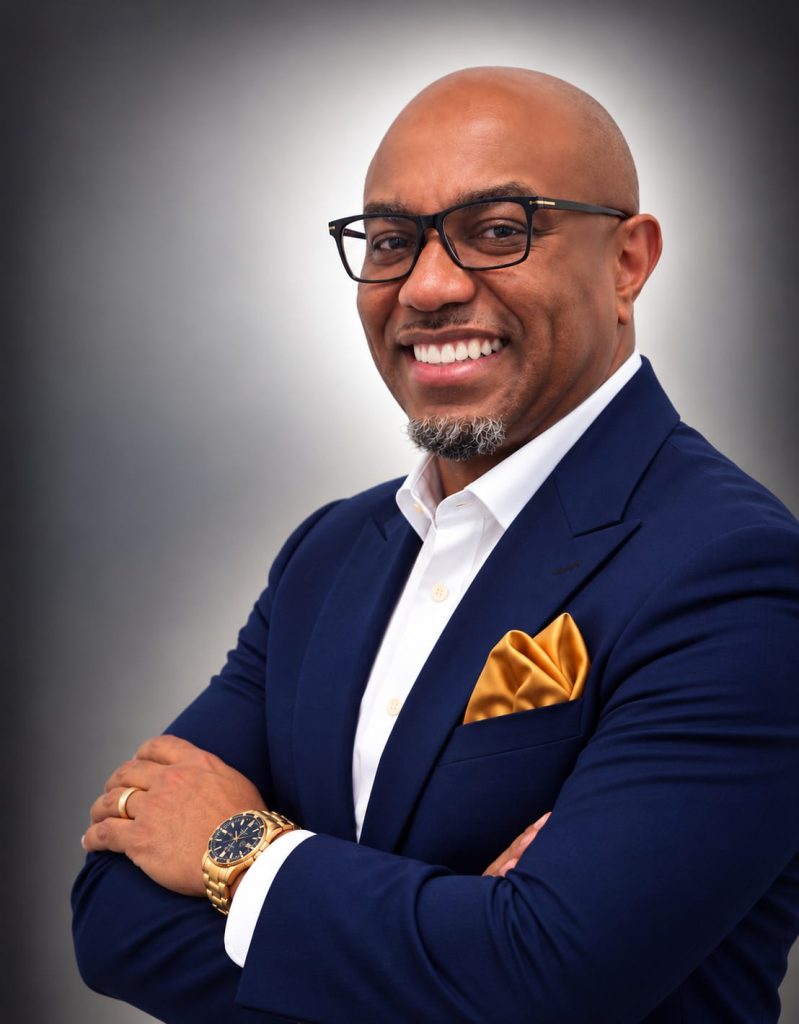
Ebere Morgan, PhD
Dr. Ebere Morgan is a global leadership futurist, systems strategist, institutional architect, author, and scholar whose work examines how people, organizations, institutions, and societies develop the leadership capacity required to shape better futures.
His professional career spans healthcare, corporate organizations, nonprofit institutions, academia, consulting, and engagements with governmental and public-sector institutions across different national and cultural contexts.
Across these environments, he has worked at the intersection of people, strategy, talent, culture, organizational performance, leadership development, and institutional effectiveness.
This breadth of experience has given him a distinctive vantage point from which to understand leadership not simply as a function of position or authority, but as a human and systems capacity for producing meaningful and sustainable change across complex institutions.
Dr. Morgan holds a doctorate degree in Organizational Leadership and has served as a senior executive, professor of leadership and strategy, consultant, and advisor. His work spans strategic development, organizational strategy, human-capital systems, institutional transformation, and the architecture of leadership pipelines.
Dr. Morgan is the CEO of Deztiny Global Leadership Consulting, Founder and President of Leadership Impact for Transformation (LIFT Global), and Founder of CIVITAS, a leadership and civic-development initiative focused on cultivating identity, agency, stewardship, and responsible citizenship in emerging generations. He is also the architect of Leadership Infrastructure Architecture (LIA), an emerging framework for approaching leadership development as a deliberate construction of systems capable of developing leadership capacity across society and across generations.
At the center of Dr. Morgan’s intellectual work is Leadership Intelligence (LQ). His scholarship explores leadership as a distinct dimension of human intelligence and investigates the relationships among people, influence, change, foresight, trust, institutions, and time. Through his writing, teaching, consulting, and institution-building, Dr. Morgan advocates a fundamental shift in how societies think about leadership: from the celebration of individual
leaders to the intentional construction of the human and institutional capacity through which leadership becomes sustainable and consequential across generations. The Fourth Dimension represents the culmination of this inquiry and introduces his most comprehensive articulation of Leadership Intelligence and its significance for individuals, organizations, institutions, and societies confronting an increasingly complex future.
A book cannot lead.
People can.
Printed in Nigeria by Gospel Warehouse Publishing. Order your copy and give one to a leader who needs it.